Introduction
Some stocks moved early on Monday.
This was before the main market opened.
Trading before the open is called premarket trading.
CrowdStrike rose.
Rivian rose.
Micron rose too.
Bank upgrades helped the first two.
A bounce after a sell-off helped the third.
What Happened
CrowdStrike rose about 3.4% before the open.
Deutsche Bank upgraded CrowdStrike to Buy from Hold.
An upgrade means a bank now thinks a stock looks better.
Buy means the bank likes the stock.
Hold means the bank thinks it is fine, but not exciting.
Deutsche Bank raised its target price to $300 from $240.
A target price is a price a bank thinks a stock could reach.
The bank said AI will push security spending up.
CrowdStrike sells security software.
Security software helps firms stop hackers.
Rivian rose about 3% before the open.
UBS upgraded Rivian to Buy from Neutral.
Neutral is like Hold.
UBS set a target price of $17.
UBS pointed to Rivian’s cheaper R2 SUV.
Rivian’s third-quarter revenue rose 38% to $2.155 billion.
That helped the bank’s case.
Micron rose about 2% before the open.
SanDisk and Western Digital rose about 2% each too.
These firms make memory chips.
Memory chips help computers store and use data.
Their shares had fallen hard in the past month.
Monday was a bounce back.
Key figures
CrowdStrike before the open: up about 3.4%
CrowdStrike target price: $300, up from $240
Rivian before the open: up about 3%
Rivian target price: $17
Rivian third-quarter revenue: $2.155 billion, up 38%
Micron before the open: up about 2%
SanDisk and Western Digital before the open: up about 2% each
Estee Lauder before the open: up about 3.5%
Why It Happened
Last week was rough for tech.
Investors worried about AI spending.
On Monday, mood improved a little.
Analysts are bank experts who study stocks.
Their upgrades gave buyers a reason to return.
Estee Lauder also rose.
Its results beat expectations.
It also raised its full-year outlook.
An outlook is a firm’s guess about its own future.
Energy shares fell, by contrast.
ExxonMobil fell 1.2%.
Chevron fell nearly 1%.
Valero fell 1.5%.
Oil prices fell on Monday.
That hurt energy shares.
Why It Matters
Early moves are not final results.
They can change after the market opens.
But they show where buyers feel brave.
On Monday, buyers felt brave about security and electric cars.
They also felt brave about memory chips again.
That matters after a hard October for tech.
It does not mean the worry is gone.
It means the worry eased for one morning.
What Happens Next
Watch the close on Monday.
Do the early gains hold?
Watch Apple earnings after the close.
Apple is a huge firm.
Its news can move the whole market.
Watch the jobs report on Friday too.
Big news can change the mood fast.
Final Thoughts
Monday started with green for some big names.
Upgrades helped.
A bounce helped.
But one morning is not a trend.
The real test comes when the market closes.
Disclaimer: This article is for educational and informational purposes only and does not constitute financial advice.
Sources: CNBC, https://www.cnbc.com/2026/11/02/stocks-making-the-biggest-moves-premarket-crwd-rivn-mu.html ; Seeking Alpha on the CrowdStrike upgrade, https://seekingalpha.com/news/4662186-crowdstrike-upgraded-to-buy-at-deutsche-bank-as-ai-drives-cybersecurity-demand ; CoinCodex on the Rivian upgrade, https://coincodex.com/article/94726/rivian-stock-jumps-3-as-ubs-upgrades-rivn-to-buy-sets-17-price-target/
Related post: https://thefinanceclass.wordpress.com/2026/11/02/us-stock-futures-rise-oil-falls-tech-rebound/
Tag: Rivian
-

CrowdStrike, Rivian and Micron Lead Monday’s Early Stock Movers
-
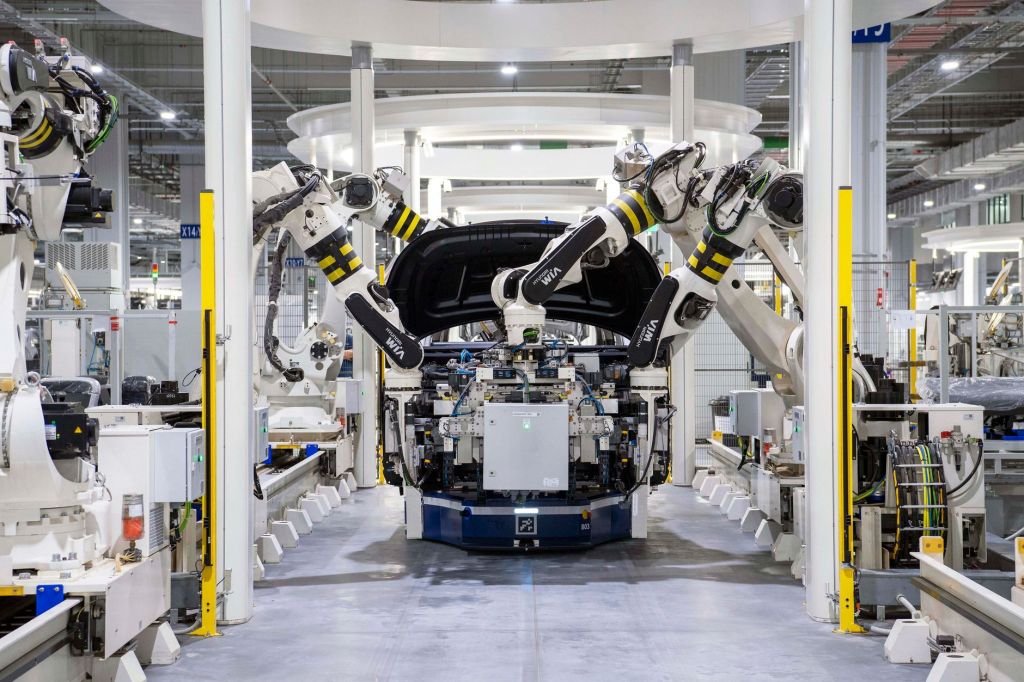
How Ford, Rivian and GM Are Using 3D Printing to Build Cars Faster and Cheaper
Introduction
Car factories are starting to print their own parts. Ford, Rivian and General Motors are now using 3D printing — also called additive manufacturing — for much more than prototypes. They are printing factory tools and selected production parts right on the factory floor, and the main reason is simple: speed.
What Happened
Rivian has spent more than $5 million on 3D-printing machines, and it spends about $1.7 million a year on printing materials. The company says the machines usually pay for themselves within a year. Parts that once took weeks to make can now be ready in days, and sometimes in hours. Rivian’s latest expansion includes machines for flexible silicone parts and a new machine bay at its plant in Normal, Illinois.
Ford has gone even further with everyday access. The company has additive-manufacturing departments at many of its plants, including a vending machine for 3D-printed F-150 parts near Dearborn, Michigan. Workers can request parts and tools through an app. Ford expects to have 3D labs at more than 23 plants by the end of this year, with more than 200 machines in its current program. In one case, a 3D-printed part kept a production line running until a replacement from a supplier arrived.
GM is using the technology on its most exclusive cars. Its hand-built Cadillac Celestiq uses 135 3D-printed components, and its Cadillac Blackwing sedans include printed parts such as a medallion on the manual shifter knob. GM has also expanded its use of industrial Stratasys printers, which can cost hundreds of thousands of dollars depending on the job, training and certification.
Why It Happened
Traditional car parts take time. A factory usually has to order a tool or part, wait for a supplier to make it, and then wait for shipping. If the part is only needed in small numbers, that wait is hard to justify.
3D printing flips that process. A digital design goes straight to a printer on site. Engineers can test a part, change the design, and print it again the same day. For tools like jigs and brackets that help workers build cars, that speed matters more than the cost of the printer itself. As Jared Beck, Rivian’s head of additive manufacturing, put it, the company is “democratizing 3D printing for the entire company” — and while savings run “well in the millions,” speed is the main point.
Key Figures
- Rivian: more than $5 million spent on 3D-printing machines; about $1.7 million a year on materials
- Rivian: machines typically pay for themselves within a year
- Ford: 3D labs expected at more than 23 plants by end of 2026; more than 200 machines in the program
- GM: 135 3D-printed components in the Cadillac Celestiq
Why It Matters
For car buyers, this is not about a single part. It is about how fast a car company can fix problems, test new ideas and keep lines moving. A factory that can print a broken tool overnight does not have to stop work while it waits for a supplier. Over time, that can mean fewer delays and lower costs — and for companies like Rivian, which is preparing its cheaper R2 SUV, lower costs are essential.
Related: Rivian Beats Earnings Expectations as Its Cheaper R2 SUV Takes the Lead
It also shows how manufacturing is changing. 3D printing used to be a lab tool for prototypes. Now it is a factory tool for real work. Companies are still not printing whole cars, and high-volume parts are still made the traditional way. But for low-volume parts and factory tools, printing is becoming normal.
What Happens Next
Expect more printers on more factory floors. Ford’s plan for 23-plus labs shows the direction, and Rivian’s new machine bay points the same way. The next test will be whether these savings show up in the companies’ results — faster production, fewer delays and lower costs per vehicle. If they do, other automakers will follow quickly.
Final Thoughts
3D printing will not replace traditional car factories. But it is already changing how those factories solve problems. When a part can be printed in hours instead of ordered in weeks, the whole factory moves faster. For an industry where every hour of downtime costs money, that is a big deal.
Disclaimer: This article is for educational and informational purposes only and does not constitute financial advice.
Sources: CNBC, “Automakers like Rivian and Ford are ‘democratizing 3D printing’ to reduce costs and increase speed” (https://www.cnbc.com/2026/10/31/automakers-3d-printing-ford-rivian-gm.html); Stratasys/Rivian factory-floor reporting on the F870 platform adoption.
-

Rivian Beats Earnings Expectations as Its Cheaper R2 SUV Takes the Lead
Rivian had a good quarter, and the market noticed. The electric vehicle maker reported third-quarter results on October 29 that beat what analysts expected, helped by its newer, cheaper SUV and growing software revenue. The next day, Jefferies upgraded the stock from Hold to Buy.
What Happened
Rivian reported revenue of $2.16 billion for the third quarter of 2026, up about 38% from a year earlier and above the $1.99 billion analysts expected. Its adjusted loss was 48 cents per share, narrower than the expected loss of 62 cents per share.
The company built 19,751 vehicles and delivered 19,248 in the quarter, both records for Rivian. Its new R2 SUV became its best-selling vehicle by volume in the quarter. Rivian also raised its full-year delivery outlook to 67,000 to 70,000 vehicles, up from 65,000 to 70,000.
Rivian’s gross profit was $176 million, an 8% gross margin. Software and services revenue reached $605 million, with a strong margin of 42%. On Friday morning, Rivian shares rose more than 5% to above $12, after closing at $11.45 on Thursday.
Jefferies analyst Philippe Houchois upgraded Rivian to Buy and kept a $17 price target. That target implies about 48% upside from Thursday’s close. The analyst pointed to stronger-than-expected conversion of preorders for the higher-end R2 launch version, and said the recent fall of roughly 30% over three months had created a better entry point.
Why It Happened
The main reason is simple: the R2 is selling. Rivian launched the R2 in March as a more affordable SUV and started delivering customer orders in June. In just one quarter, it became the company’s top-selling model by volume. A cheaper model opens the door to far more buyers than Rivian’s earlier, more expensive trucks and SUVs.
Software is the second part of the story. Rivian earns money not only from selling vehicles but also from software and services. That revenue grew fast and carries a high margin, which helps the company lose less money on each vehicle it sells.
Costs also helped. Rivian cut its capital spending plans by $300 million at the midpoint, and it still held $5.5 billion in cash at the end of September. That gives it room to keep building while it works toward profitability.
Why It Matters
For a long time, the big question about Rivian was simple: can it ever make money? This quarter does not answer that question fully. Rivian still expects an adjusted EBITDA loss of $1.75 billion to $1.85 billion for the full year. But it does show progress on the path that matters most: selling more vehicles, at better margins, with a product more people can afford.
It also matters for the wider EV market. After a tough period for electric vehicle makers, a clean beat from Rivian — and an upgrade from a major bank — is a sign that demand for well-priced EVs is still there. Jefferies also argued that Rivian sits in a useful price gap, between cheaper Tesla models and Ford’s upcoming lower-cost EV, which may not ramp up until late 2027.
Key Figures
Figure Q3 2026 Revenue $2.16 billion, up 38% year over year Adjusted loss per share $0.48, vs $0.62 expected Vehicles produced 19,751 Vehicles delivered 19,248 Gross profit $176 million, 8% margin Full-year delivery outlook 67,000–70,000 vehicles Jefferies price target $17, vs $11.45 Thursday close What Happens Next
The next test is whether Rivian can keep the R2 ramp going. CEO RJ Scaringe has said production needs to go well above current plans — he has pointed to more than 160,000 units — before the company as a whole can turn profitable. Watch the fourth quarter for delivery numbers, R2 margins, and any update on that production ramp.
Investors should also watch cash. Rivian has $5.5 billion, but it is still losing money. How fast it burns through that cash while scaling up will decide how much time it has to prove the R2 story.
Final Thoughts
Rivian’s quarter was a step in the right direction: more vehicles, more revenue, smaller losses, and a higher delivery outlook. The Jefferies upgrade shows Wall Street is starting to notice. But Rivian is still a company in transition, not yet profitable. The R2 has given it momentum. Now it has to turn that momentum into scale.
Disclaimer: This article is for educational and informational purposes only and does not constitute financial advice.
Sources: CNBC, “Rivian earnings beat estimates as software revenue, R2 deliveries rise” (https://www.cnbc.com/2026/10/29/rivian-rivn-earnings-q3-2026.html); TipRanks, “Rivian Stock (RIVN) Jumps on Jefferies Buy Upgrade as R2 Demand Fuels Q3 Growth” (https://www.tipranks.com/news/rivian-stock-rivn-jumps-on-jefferies-buy-upgrade-as-r2-demand-fuels-q3-revenue-growth)
See also our earnings coverage this week — Amazon’s earnings miss and cloud growth: https://thefinanceclass.wordpress.com/2026/10/30/amazon-shares-fall-earnings-miss-cloud-growth/

